 USA AI Tools
APA vs MLA Citations: Simple Cheat Sheet with Examples
 By Naumann Nasir · Last updated
APA and MLA are the two citation styles students meet most often. APA (American Psychological Association) is common in psychology, education, nursing and social sciences. MLA (Modern Language Association) is common in English, languages and the humanities. Always follow your instructor's instructions first, because rules can differ by class. The examples below follow APA 7th edition and MLA 9th edition. In this November 3, 2026 update I also cited a real news article with the site's Citation Generator in both styles and checked the results against the official APA and MLA guidance, including four things the tool gets wrong or leaves to you.
The main difference in one sentence
APA puts the date near the front because recent research matters. MLA focuses on the author and page because close reading of texts matters.
In-text citations
| APA 7 | MLA 9 | |
|---|---|---|
| Paraphrase | (Smith, 2023) | (Smith) |
| Direct quote | (Smith, 2023, p. 45) | (Smith 45) |
| Two authors | (Smith & Lee, 2023) | (Smith and Lee 45) |
| Three or more authors | (Smith et al., 2023) | (Smith et al. 45) |
Reference list vs Works Cited
APA calls the final list "References". MLA calls it "Works Cited". Both are alphabetical by author's last name and use a hanging indent, where the second and later lines of each entry are indented.
Book example
APA: Smith, J. (2023). Understanding teen sleep. Oak Publishing.
MLA: Smith, Jane. Understanding Teen Sleep. Oak Publishing, 2023.
Website example
APA: Smith, J. (2024, March 12). How much sleep do teens need? Sleep Health Hub. https://example.com/teen-sleep
MLA: Smith, Jane. "How Much Sleep Do Teens Need?" Sleep Health Hub, 12 Mar. 2024, example.com/teen-sleep.
Journal article example
Scholarly articles are where the two styles look most different, so it helps to see them side by side.
APA: Lee, K., & Alvarez, M. (2022). School start times and teen alertness. Journal of Adolescent Health Studies, 14(2), 101-118. https://doi.org/10.0000/example
MLA: Lee, Karen, and Maria Alvarez. "School Start Times and Teen Alertness." Journal of Adolescent Health Studies, vol. 14, no. 2, 2022, pp. 101-18.
Notice that APA italicizes the journal name and the volume number together and puts the issue in parentheses. MLA spells out "vol." and "no." and shortens the second page number when it can (118 becomes 18). The DOI is the permanent link for the article, and both styles welcome it when you have one.
Worked example: citing a real article with the Citation Generator
The source is a real news story: Tom Warren's article "Microsoft's Office and Teams chief is leaving", published on The Verge on October 1, 2026. I entered it in the Citation Generator once for each style.
APA 7
APA's own webpage reference examples say an article on a news website (they name sites such as CNN, HuffPost and Reuters) needs the writer, the specific publication date, the title in italic sentence case, the site name and the URL. The tool only has a "Year published" box, but it prints whatever you type inside the brackets, so I typed 2026, October 1.
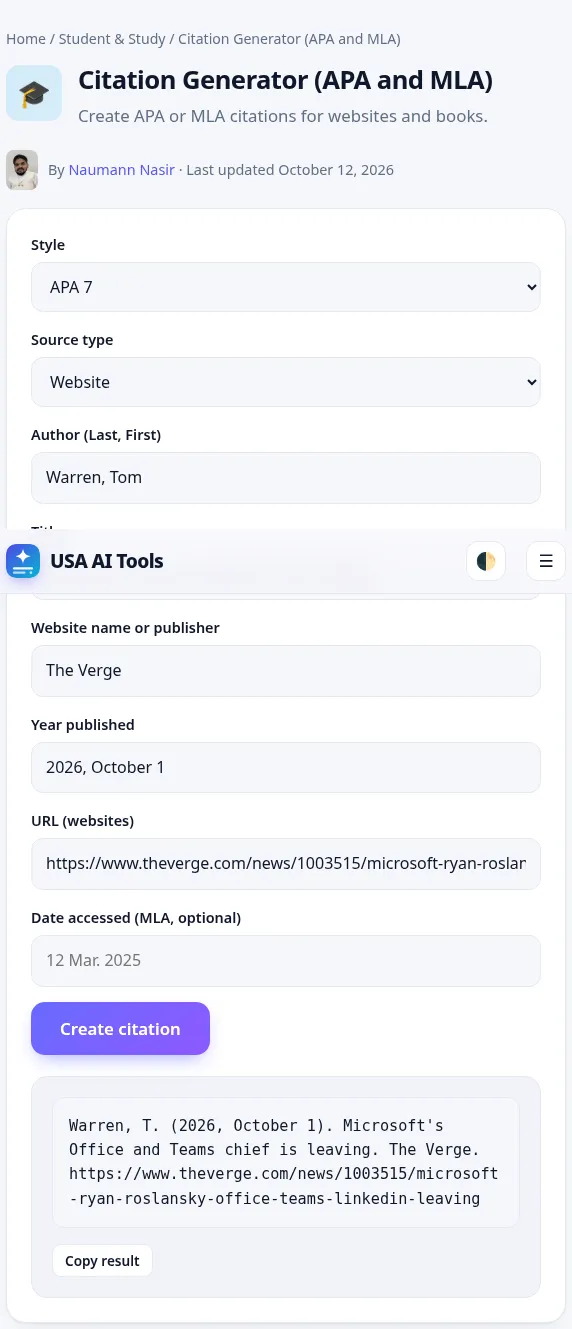
The order and punctuation match APA's examples: Warren, T. (2026, October 1). Microsoft's Office and Teams chief is leaving. The Verge. https://www.theverge.com/news/1003515/microsoft-ryan-roslansky-office-teams-linkedin-leaving. It turned "Warren, Tom" into "Warren, T." correctly. One thing is missing: the article title should be in italics, and the tool's output is plain text. Italicise the title after you paste it.
MLA 9
For MLA I typed the title in title case, the date as 1 Oct. 2026 (MLA's day-month-year style with an abbreviated month) and an access date.
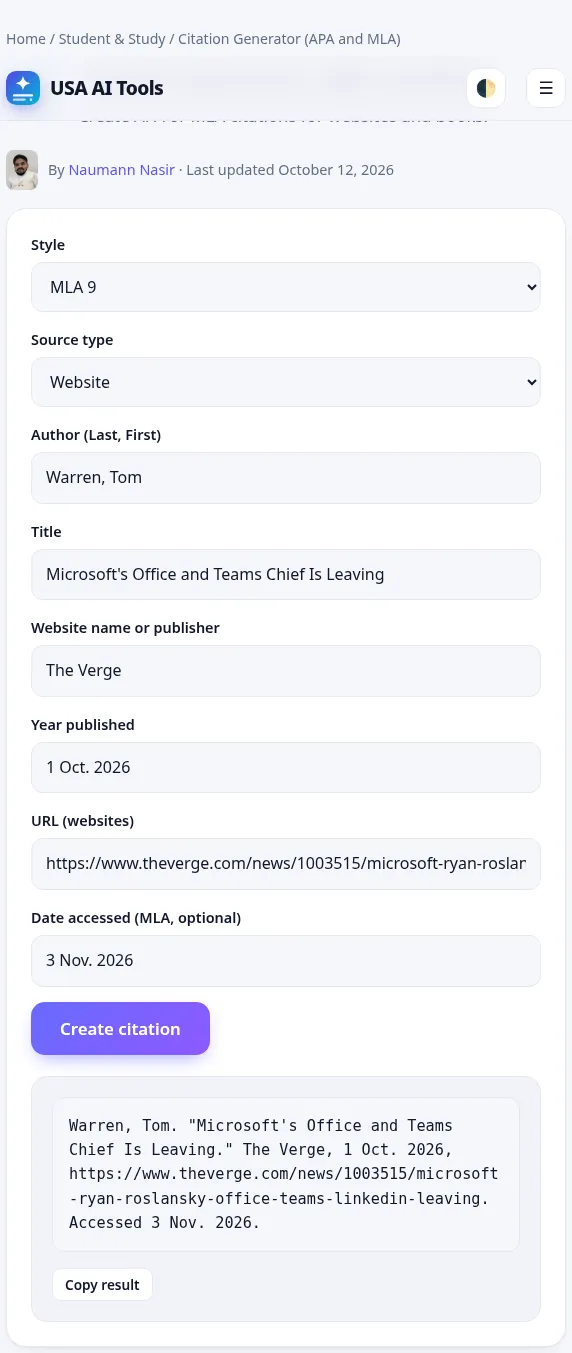
The structure is right: author, title in quotation marks, container, date, location, optional access date. Two fixes before it goes in a Works Cited list:
- Drop "https://". The MLA Style Center's advice on URLs is that you can usually leave out http:// or https://. The tool keeps it. (Keep "https://doi.org/" in front of a DOI, though.)
- Italicise the container. The Verge should be in italics. Again, the output is plain text.
Corrected: Warren, Tom. "Microsoft's Office and Teams Chief Is Leaving." The Verge, 1 Oct. 2026, www.theverge.com/news/1003515/microsoft-ryan-roslansky-office-teams-linkedin-leaving. Accessed 3 Nov. 2026.
What the Citation Generator does not do for you
I also tested a few edge cases by running the tool's code directly. The tool is a formatter: it puts what you type in the right order with the right punctuation, and nothing more. In practice that means:
- No capitalisation changes. It does not convert titles to APA sentence case or MLA title case. Type the title the way the style wants it, which is why I typed it twice above.
- No italics. Book titles, webpage titles in APA, and containers in MLA all need italics added by hand.
- Dates are whatever you type. Leaving the year blank gives "(n.d.)" in APA, which is correct. In MLA, a blank date leaves a stray double comma (", , ") in the entry, so delete it.
- Group authors need care. With "World Health Organization" as the author and no site name, the APA output was "World Health Organization (2018, May 24). The top 10 causes of death. . https://…": the full stop after the author is missing and an empty site leaves ". .". APA's own example is "World Health Organization. (2018, May 24). The top 10 causes of death. https://…", so fix both by hand.
- Only websites and books. For journal articles, use the patterns in the journal section above.
A book worked cleanly in both styles: entering Daniel Kahneman's Thinking, Fast and Slow (Farrar, Straus and Giroux, 2011) gave "Kahneman, D. (2011). Thinking, fast and slow. Farrar, Straus and Giroux." in APA (title typed in sentence case) and "Kahneman, Daniel. Thinking, Fast and Slow. Farrar, Straus and Giroux, 2011." in MLA. Both just need the title italicised.
Quoting and paraphrasing
Suppose your source says, on page 45, that teens need about eight to ten hours of sleep. If you paraphrase, you are putting the idea in your own words, and you still cite it. If you quote it, you copy the exact words inside quotation marks.
APA paraphrase: Teenagers generally need more sleep than adults do (Smith, 2023).
APA quote: Smith (2023) argued that "most teens run a nightly sleep debt" (p. 45).
MLA paraphrase: Teenagers generally need more sleep than adults do (Smith 45).
MLA quote: Smith argues that "most teens run a nightly sleep debt" (45).
Long quotations work differently. In APA, a quote of 40 words or more goes in a separate indented block without quotation marks. MLA uses a block when the quote runs more than four lines of prose. In both cases, try to use block quotes rarely. A paragraph made mostly of other people's words does not show your own thinking.
Step by step: citing one source from scratch
- Identify the source type: book, journal article, web page, video or something else. The type decides which pattern you follow.
- Write down the author, title, container (for example the journal or website), publisher, date and link.
- Put the pieces in the order your style requires. APA starts with author and date. MLA starts with author and title.
- Format the details: italics for book and journal titles, quotation marks for article titles in MLA, sentence case in APA.
- Add the matching short citation at the spot in your paper where you used the source.
- Alphabetize the full entry in your list and check the hanging indent.
Common mistakes
- Mixing styles. Using an APA year in parentheses inside an MLA paper is one of the easiest errors to make when you copy from different tools.
- Missing page numbers on quotes. Both styles expect a page or paragraph number when you quote directly, if the source has one.
- Wrong order in the list. Entries are alphabetical by the first word, usually the author's last name, not by date or by the order you used them.
- Citing a source you never opened. If you only read a summary of a study, cite the summary or track down the original.
- Leaving out the author when there is none. Use the title instead. In the short citation, use the first few words of the title in quotation marks.
Key differences at a glance
- Author names: APA uses last name and initials (Smith, J.). MLA uses the full name as printed (Smith, Jane).
- Titles: APA uses sentence case for article and book titles. MLA uses title case.
- Dates: APA puts the year in parentheses after the author. MLA puts the date later in the entry.
- URLs: APA includes the full URL. MLA usually drops "https://".
- Access dates: APA generally does not require them. MLA treats them as optional.
Tips to avoid mistakes
- Collect source details while you research: author, title, publisher or website, date and URL.
- Check that every in-text citation has a matching entry in the list, and the other way around.
- Do not trust automatic citations blindly. They often get capitalization and dates wrong.
- Ask your instructor which edition and style variations they want.
Quick takeaways
- APA highlights the year, MLA highlights the author and page.
- APA calls the list "References", MLA calls it "Works Cited".
- Use sentence case for titles in APA and title case in MLA.
- Every in-text citation needs a matching list entry.
- Follow your instructor's rules first, then the style guide.
Frequently asked questions
Which style should I use if my teacher does not say?
Ask. If you cannot, choose the style common in the subject: APA for psychology, education and most social sciences, MLA for literature and language classes. Then use that style consistently from start to finish.
Do I need to include the URL?
APA asks for the full link for web sources. MLA allows you to drop "https://" and treats the link as recommended. If a page has a DOI, use that for either style.
What if a web page has no date?
In APA, write "n.d." where the date would go. In MLA, leave the date out and consider adding the date you accessed the page at the end of the entry.
Are online citation generators reliable?
They save time on order and punctuation, but they cannot fix the details you give them. Generators that pull data from a page often miss author names or use the wrong capitalization, and a simple formatter like ours leaves italics and capitalisation to you. Treat the output as a draft and check it against a style guide.
How do I cite a news article with a full date in APA?
Use the writer, then the full date in brackets as (year, Month day), then the title in italic sentence case, the site name and the URL, as in the Verge example above. In our tool, type the date as "2026, October 1" in the year box.
Create a citation quickly
Use our free Citation Generator to build a basic APA or MLA citation for a website or book. Always compare the result with your style guide or school library resources for unusual sources. If you are planning a paper, our essay outline guide shows how to keep track of evidence as you write.
Try the tool: Citation Generator (APA and MLA)
Create APA or MLA citations for websites and books.
Open toolMore free student & study tools
AI Essay Outline Generator
Get a clear essay outline with thesis and section ideas.
AI🎓AI Flashcard Maker
Turn notes into question-and-answer flashcards.
AI🎓GPA Calculator
Calculate your GPA on the 4.0 scale from grades and credits.