 USA AI Tools
How Long Will My Script Take to Read Aloud? Words to Minutes
 By Naumann Nasir · Last updated
Two pieces of news this month made script length a practical question again. On October 26, Instagram started testing "Features", horizontal videos up to 90 minutes long that short Reels can link to. And on October 20, Mistral released Voxtral TTS 3, a text-to-speech model priced per character. Whether you record your own voice or generate one, you start with the same two numbers: how many words, and how fast they will be spoken.
Here is how I estimate both with the site's free tools, using a real 244-word script I wrote for this post, plus where the estimates can be off.
The basic formula
Spoken time in minutes = word count / speaking rate in words per minute (wpm).
The hard part is the rate. The best-known reference is Marc Brysbaert's 2019 meta-analysis of reading rate in the Journal of Memory and Language. Across the studies it reviewed, adults read English non-fiction silently at about 238 wpm and read aloud at about 183 wpm. Scripts for video usually include pauses for emphasis and for what is happening on screen, so the site's Reading Time Calculator uses 238 wpm for silent reading and a more cautious 150 wpm for reading aloud, which leaves room for those pauses.
Worked example: a short how-to voiceover
My test script is a five-step voiceover for a short video about putting a café menu behind a QR code. It opens with "If your café still hands out paper menus, here is a two-minute fix" and ends with a call to save the video. I pasted the whole script into the Reading Time Calculator:
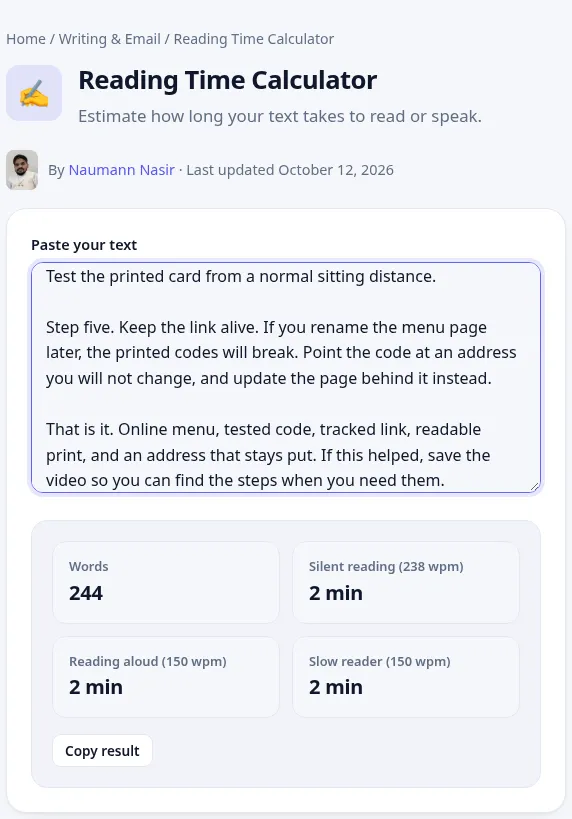
The tool says 244 words and 2 min for both silent reading and reading aloud. That needs one caveat: the calculator rounds every result up to the next whole minute. The unrounded numbers tell a more useful story:
| Rate | Where it comes from | Time for 244 words |
|---|---|---|
| 238 wpm | Silent reading (Brysbaert 2019) | about 1 min 2 s |
| 183 wpm | Reading aloud (Brysbaert 2019) | about 1 min 20 s |
| 150 wpm | The tool's read-aloud setting | about 1 min 38 s |
So "two-minute fix" in the script's opening line is honest at a relaxed pace, and the script will probably run between 1:20 and 1:40 once recorded. If the video has to land under a hard limit, plan from the slower number and cut words, not pace.
Find your own speaking rate
Averages are a starting point. The quickest way to get your number:
- Pick a passage of 150 to 300 words that sounds like your normal scripts.
- Read it out loud once at the pace you would use on camera, with a stopwatch running.
- Divide the word count by the minutes. 244 words in 1.5 minutes is about 163 wpm.
- Use that number for future scripts: words / your wpm = minutes.
Do this once for each style you use. A calm tutorial and an energetic product teaser can differ a lot, even from the same person.
What 90 minutes actually means in words
Instagram's new Features allow up to 90 minutes. Fully scripted, that is a lot of text:
- At 150 wpm: 90 x 150 = 13,500 words.
- At 183 wpm: 90 x 183 = about 16,500 words.
Many long videos, such as podcasts and interviews, are not read from a full script. But if you are scripting an intro, segment links and a closing, the same math tells you how much of your runtime those scripted parts take.
For the short clips that link to a long video, keep in mind The Hollywood Reporter's description of Reels as "typically around three minutes or less". At 150 wpm, three minutes is about 450 words, and a 30-second clip is about 75 words.
Estimating text-to-speech cost from characters
Many TTS services charge by characters, not words. Mistral lists Voxtral TTS 3 at $13 per million characters on its model page. To estimate, paste the script into the Character Counter:
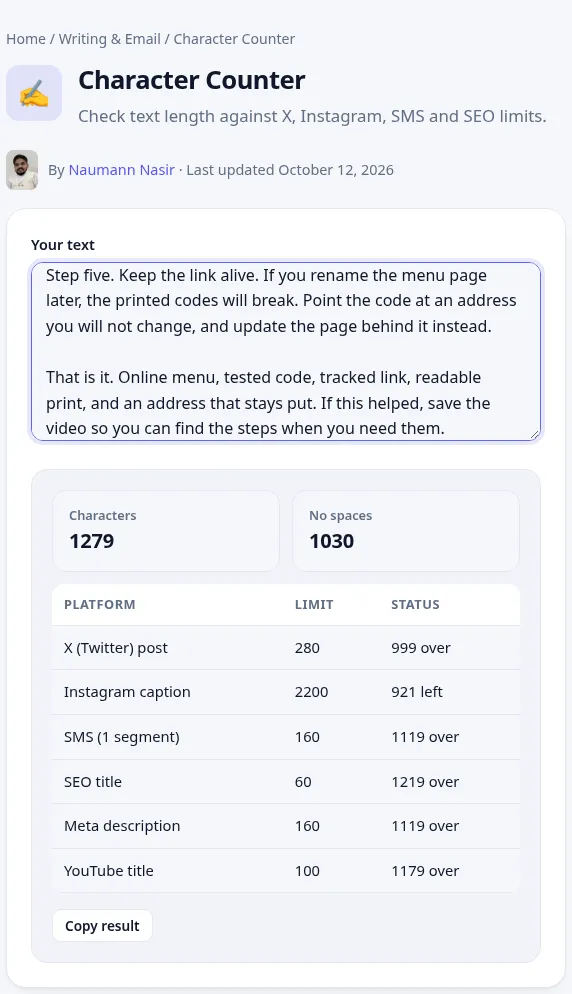
The script is 1,279 characters with spaces (1,030 without). At $13 per million, one generation costs about 1,279 x 13 / 1,000,000 = $0.017. Check whether your provider counts spaces and punctuation before you rely on the lower figure.
My script works out to about 5.2 characters per word including spaces. If you only know a word count, multiplying by 5 to 6 gives a rough character count. A fully scripted 13,500-word piece would be roughly 70,000 characters, or a bit under $1 per generation at that price. Re-generating after edits multiplies that, so finish editing the text before you generate the audio.
Why TTS timing can differ from your estimate
- Voices have their own pace. Two voices reading the same text can differ in length. Voxtral TTS 3, for example, lists pace tags among its features, so the same script can be made faster or slower.
- Numbers and symbols expand. "$13" is spoken as "thirteen dollars", and a URL can take several seconds to read aloud. Spell out anything you want read a specific way.
- Pauses add up. Paragraph breaks, demos and on-screen text all add time that a word count does not see. Add a margin of 10 to 20 percent for a tutorial with screen recordings.
Trimming a script that runs long
- Cut the warm-up. Openers like "Hey everyone, welcome back" cost seconds before the viewer gets anything.
- Remove repeated summaries. If a step is clear on screen, the voiceover does not need to repeat it word for word.
- Turn lists into a visual. Five settings on screen beat five settings read aloud.
- Re-run the word count after each pass. The Word Counter or the Reading Time Calculator show the new length instantly.
If you are trimming written source material into a script, How to Summarize Long Articles Fast covers how to keep the claims that matter. When the video is ready, YouTube Title Formulas helps with the title.
Limitations of the Reading Time Calculator
- It rounds up to whole minutes, which hides the difference between a 1:05 and a 1:55 script. For short scripts, divide the word count yourself.
- The read-aloud speed is fixed at 150 wpm. You cannot type your own rate.
- The third row, "Slow reader (150 wpm)", currently uses the same 150 wpm as the read-aloud row, so it shows the same number. Treat it as a duplicate.
- It counts words separated by spaces. Text in other scripts, or numbers like "2,000", may not be counted the way you would speak them.
Quick takeaways
- Minutes = words / wpm. Use 150 wpm as a cautious default and your own timed rate when you have it.
- Brysbaert's 2019 review puts adult read-aloud speed at about 183 wpm and silent reading at about 238 wpm.
- For TTS, count characters as well as words, since many providers charge per character.
- Always do one real read-through before you record or generate the final audio.
Frequently asked questions
How many words is a 1-minute script?
About 150 words at a relaxed pace, or about 180 if you read briskly. Time yourself once to find your own number.
How many words is a 10-minute speech?
Roughly 1,500 words at 150 wpm. If you plan pauses, audience reactions or slides, aim lower, around 1,300 to 1,400 words.
Is text-to-speech faster than a human reading?
It depends on the voice and its settings. Generate a short sample, measure its length, and divide its word count by its duration to get that voice's wpm.
More free writing & email tools
AI Email Writer
Write a clear, professional email from a few bullet points.
AI✍️AI Cover Letter Generator
Create a tailored cover letter for any job in seconds.
AI✍️AI Paragraph Rewriter
Rewrite any paragraph to be clearer, shorter or more polished.
AI