 USA AI Tools
How to Convert Hourly Pay to Annual Salary (and Back)
 By Naumann Nasir · Last updated
Job posts and offer letters mix hourly rates and annual salaries as if they were interchangeable. They are not, unless you know the hours and weeks behind the number. A "$28 an hour" role and a "$58,000 a year" role can be the same job, or they can be thousands of dollars apart once you count unpaid time off, overtime rules and a shorter week.
This guide shows how to convert either way with the free Salary Converter and the Work Hours Calculator on this site. Every figure below comes from those tools with the inputs shown. The results are before tax and are not financial advice.
The simple formula (and why it is not enough)
The shortcut people quote is:
- Hourly to yearly: hourly rate × hours per week × weeks per year
- Yearly to hourly: yearly salary ÷ (hours per week × weeks per year)
Most websites quietly assume 40 hours and 52 weeks. That is 2,080 hours a year. It is a useful default, but it fails when you work 35 hours, take unpaid leave, or have a schedule that is not a clean 9-to-5. The tools on this site let you change both hours and weeks so the conversion matches your real calendar.
Example 1: $28 an hour to annual salary
Open the Salary Converter. Enter 28 as the amount, choose Hour, keep 40 hours per week and 52 weeks worked per year.
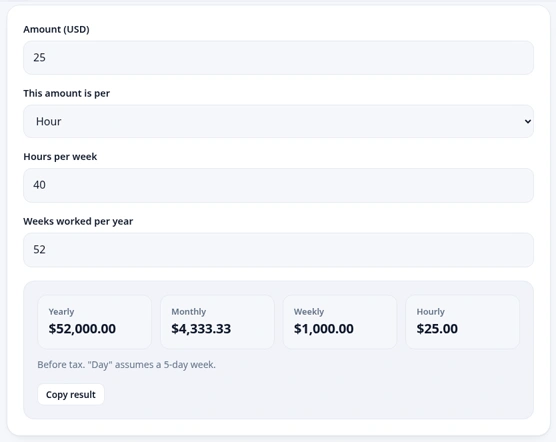
The tool returns:
- Yearly: $58,240.00
- Monthly: $4,853.33
- Weekly: $1,120.00
- Hourly: $28.00
That is the clean 40 × 52 case. If you only get paid for 50 weeks because two weeks are unpaid, change weeks to 50. The same $28 an hour becomes $56,000.00 a year and $4,666.67 a month. The hourly rate did not change; the year got shorter.
Example 2: $65,000 a year back to hourly
Enter 65000, choose Year, keep 40 hours and 52 weeks.
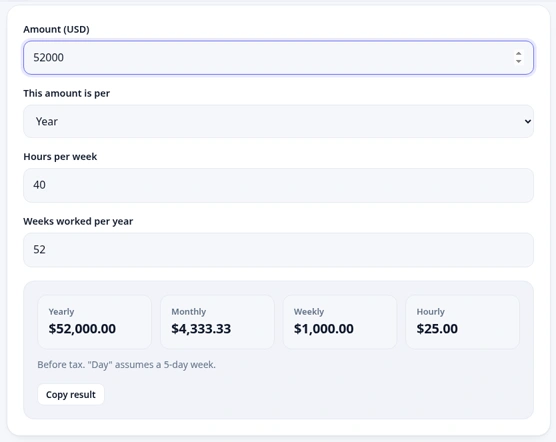
Results:
- Yearly: $65,000.00
- Monthly: $5,416.67
- Weekly: $1,250.00
- Hourly: $31.25
If the role includes four weeks of paid time off and you want the hourly rate for the weeks you actually work, set weeks to 48. The tool still shows $65,000 a year, but the hourly figure rises to $33.85 and the weekly figure to $1,354.17. That is useful when you compare a salaried job to an hourly one with similar take-home time.
Example 3: part-time and non-standard weeks
Not every job is 40 hours. Try $22.50 an hour, 35 hours a week, 52 weeks:
- Yearly: $40,950.00
- Monthly: $3,412.50
- Weekly: $787.50
Or a side gig at $18 an hour, 25 hours a week, 50 weeks (two weeks off unpaid):
- Yearly: $22,500.00
- Monthly: $1,875.00
- Weekly: $450.00
Using 40 × 52 on that $18 rate would invent a fake $37,440 "full-time equivalent" that you never earn. Always convert with the hours you actually work unless you are deliberately comparing full-time equivalents.
Monthly pay is not yearly ÷ 12 in every payroll
Enter 4500, choose Month, 40 hours, 52 weeks. The converter treats a month as one-twelfth of a year, so:
- Yearly: $54,000.00
- Weekly: $1,038.46
- Hourly: $25.96
Some employers pay biweekly (26 checks) or semimonthly (24 checks). The tool's "2 weeks" option is for a biweekly amount: it assumes your amount arrives 26 times a year when weeks worked is 52. If your stub shows a different cycle, convert to yearly first with the number of checks you truly receive, then convert down to hourly.
Check the hours on the schedule, not the job title
Salary job descriptions often hide long days. Use the Work Hours Calculator before you trust an hourly conversion.
Example A: 9:00 to 17:30 with a 30-minute unpaid break, five days a week, at $28 an hour:
- Hours per day: 8.00
- Hours per week: 40.00
- Pay per day: $224.00
- Pay per week: $1,120.00
That matches the $58,240 yearly figure from earlier. Example B: 10:00 to 18:00 with a 60-minute unpaid break, four days a week, at $32 an hour:
- Hours per day: 7.00
- Hours per week: 28.00
- Pay per week: $896.00
At 52 weeks, 28 × 52 × $32 = $46,592 a year. If someone casually calls this a "$32 an hour job" next to a 40-hour "$28 an hour" role, the lower rate still pays more annually. Hours decide the race.
Salaried roles with long weeks
Suppose an offer is $85,000 a year for a schedule that regularly runs about 45 hours a week and about 50 working weeks after holidays. In the Salary Converter: amount 85000, period Year, hours 45, weeks 50:
- Hourly: $37.78
- Weekly: $1,700.00
- Monthly: $7,083.33
Compare that with a straight 40 × 52 conversion of the same salary, which is $40.87 an hour. The "extra" hours cut the effective rate by a few dollars. For a deeper walkthrough that folds in benefits and PTO, see How to Compare Two Job Offers.
Overtime, tips and commissions
The converter does not add overtime premiums, tips or commission. For non-exempt hourly work in the US, overtime is often time-and-a-half after 40 hours in a week, but state rules vary. A rough check is: run your base hours through the tool, then add overtime hours × 1.5 × your rate yourself. Tips and commissions belong in a separate yearly estimate, then you can convert that total to hourly if you want a blended rate.
Common mistakes when converting pay
- Always using 2,080 hours. Part-time, four-day weeks and unpaid leave need different hours and weeks.
- Comparing a salary to an hourly rate without matching hours. Convert both to the same unit first.
- Treating gross and take-home as the same. These tools show pre-tax amounts.
- Ignoring unpaid breaks. A shift from 8:00 to 16:00 with no unpaid break is 8 hours; the same clock times with a 30-minute unpaid lunch is 7.5.
- Annualizing a busy season. Ten weeks at 50 hours is not the same as a 50-hour year-round job.
Quick checklist
- Write down the amount and whether it is hourly, daily, weekly, monthly or yearly.
- Confirm hours per week with the Work Hours Calculator if your schedule is not a clean 40.
- Choose weeks per year honestly: 52 for year-round paid work, fewer if you have unpaid downtime.
- Run the Salary Converter and save the yearly and hourly results side by side.
- If you are choosing between offers, continue with the job offer comparison guide so benefits and PTO are counted too.
Once both sides of a comparison use the same hours and weeks, the louder number on the job post usually stops mattering as much as the quieter one on your calendar.
More free job & resume tools
AI Resume Bullet Improver
Turn weak resume lines into strong, results-focused bullets.
AI💼AI LinkedIn Headline Generator
Get 8 headline options that attract recruiters.
AI💼AI Interview Question Generator
Practice with likely interview questions and answer tips.
AI