 USA AI Tools
Planning a Car Purchase: Loan Payment, Down Payment and Budget
 By Naumann Nasir · Last updated
Buying a car usually involves three money questions at once: how big a down payment you need, what the monthly loan payment will be, and whether that payment fits the rest of your budget. Most people look at them one at a time, often at the dealership, which is the worst place to be doing maths under pressure.
This guide answers all three before you shop, using a worked example and four free calculators on this site: the Loan and EMI Calculator, the Savings Goal Calculator, the Budget Planner and the Percentage Calculator. All numbers below come from those tools with the inputs shown. They are estimates before taxes and fees, not financial advice.
The example
Suppose you are looking at a car with an out-the-door price of $28,000. Your monthly take-home pay is $4,200, you already have $1,200 saved towards the car, and you can put aside $400 a month. A lender has pre-approved you at 7.9% APR. These figures are made up for the example; swap in your own as you read.
Step 1: See what the loan costs at different terms
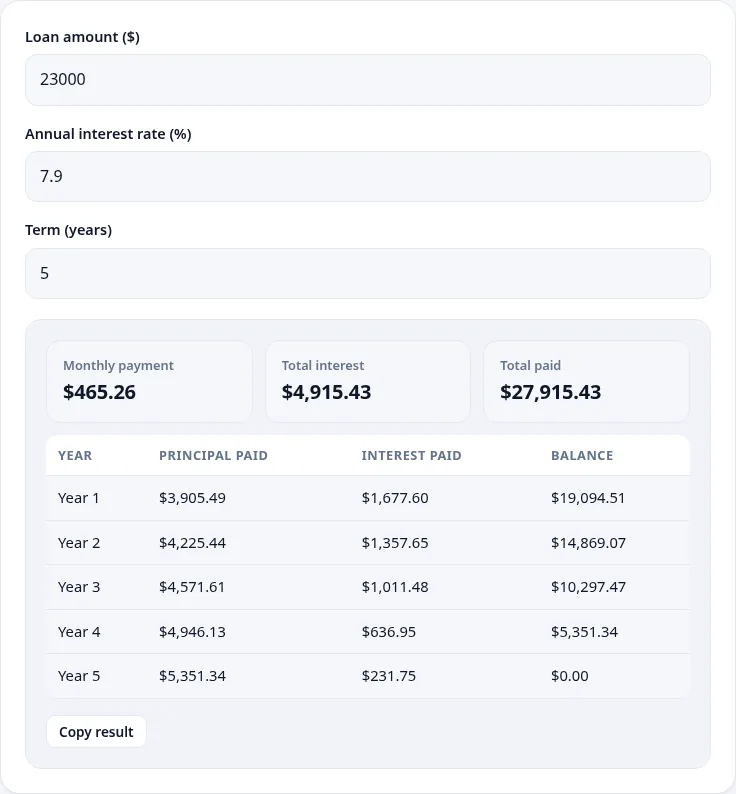
Start with a $5,000 down payment, which leaves a $23,000 loan. Enter $23,000, 7.9% and a term in years into the Loan and EMI Calculator, then change only the term:
| Term | Monthly payment | Total interest | Total paid |
|---|---|---|---|
| 4 years | $560.42 | $3,900.07 | $26,900.07 |
| 5 years | $465.26 | $4,915.43 | $27,915.43 |
| 6 years | $402.14 | $5,954.25 | $28,954.25 |
Stretching from 4 to 6 years lowers the monthly payment by about $158, but it adds $2,054.18 in interest. Longer terms make a car feel cheaper each month while making it more expensive overall. There is another risk: cars lose value, and on a long loan you can owe more than the car is worth for several years.
The yearly table is worth a look too. On the 5-year loan, the first year's payments include $1,677.60 of interest and $3,905.49 of principal. By year five, interest is down to $231.75. Early payments are interest-heavy because interest is charged on a larger balance.
Step 2: Check whether the payment fits your budget
Next, see how a car payment fits alongside everything else. The Budget Planner splits take-home pay using the 50/30/20 rule of thumb: 50% for needs, 30% for wants and 20% for savings and debt repayment. For $4,200 a month it gives:
- Needs: $2,100.00
- Wants: $1,260.00
- Savings and debt: $840.00
Where does a car payment belong? If you need the car to get to work, the minimum payment is usually treated as a need. Your rent, groceries, utilities, insurance and other essentials also have to fit in that $2,100.
To see the payment as a share of income, use the Percentage Calculator: $465.26 is 11.08% of $4,200. That is before car insurance, fuel, parking and maintenance, which can add a lot. Many budgeting guides suggest keeping total car costs, not just the loan payment, to a modest share of take-home pay. Whatever limit you choose, set it before you visit a dealer.
Step 3: Decide how much to save for the down payment
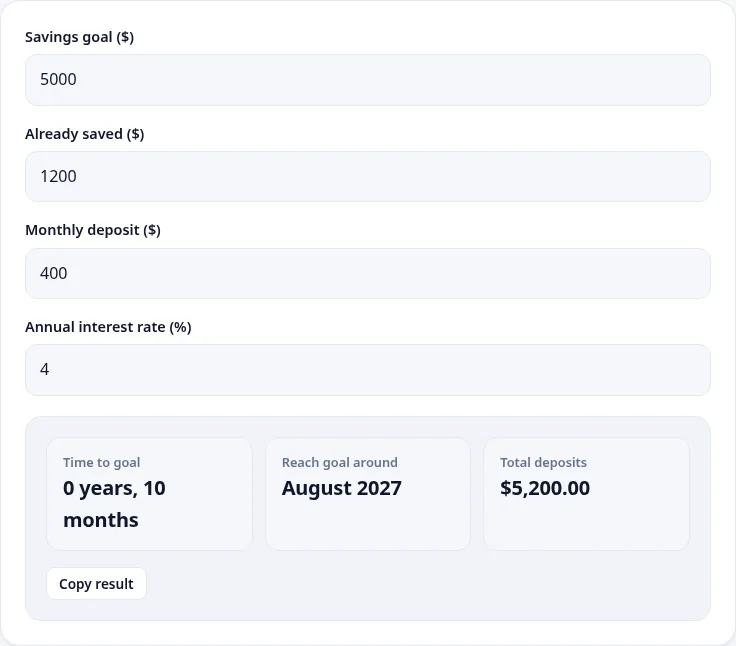
A bigger down payment means a smaller loan. To see what saving longer would buy you, run the Savings Goal Calculator with your $1,200 already saved, $400 a month and a 4% savings rate:
- Goal $5,000: about 10 months, around August 2027 if you start now, with $5,200 deposited in total including your starting $1,200.
- Goal $8,000: about 1 year and 5 months, around March 2028.
Now compare the two loans. With $8,000 down, the loan is $20,000. At 7.9% for 5 years the calculator gives $404.57 a month and $4,274.28 of total interest. Compared with the $23,000 loan over the same 5 years, that is about $61 less each month and $641.15 less interest.
Is waiting seven more months worth it? That depends on how urgently you need the car, whether car prices or rates are likely to change, and what your current car is costing you in repairs. The calculators cannot make that call, but they put a clear price on each option.
Step 4: Put the options side by side
| Option | Down payment | Ready to buy | Monthly payment | Total interest |
|---|---|---|---|---|
| A: buy sooner, 5-year loan | $5,000 | about 10 months | $465.26 | $4,915.43 |
| B: buy sooner, 4-year loan | $5,000 | about 10 months | $560.42 | $3,900.07 |
| C: save longer, 5-year loan | $8,000 | about 17 months | $404.57 | $4,274.28 |
| D: buy sooner, 6-year loan | $5,000 | about 10 months | $402.14 | $5,954.25 |
Option D and option C have almost the same monthly payment, but D costs $1,679.97 more in interest and keeps you in debt a year longer. Option B costs the least interest but needs the highest monthly payment. Seeing these together makes trade-offs much clearer than any single quote.
If you have a car to trade in
A trade-in works like extra down payment. If your current car is worth $3,000 as a trade-in and you add your $5,000 of savings, you put $8,000 towards the new car, which is the same loan as option C: $20,000, or $404.57 a month over 5 years. That could let you buy sooner without the longer loan.
Two cautions. First, get a trade-in value from more than one place, because offers can differ. Second, if you still owe money on your current car, the trade-in only helps by the amount it is worth above what you owe. If you owe more than it is worth, that negative equity is often added to the new loan, which raises the loan amount. Run the new figure through the loan calculator before agreeing.
What the calculators leave out
A loan calculator assumes a fixed rate and equal monthly payments. Real car purchases include other costs that you should add separately:
- Sales tax, title and registration, which vary by state. If they are rolled into the loan, the loan amount is higher than the car's price. The Sales Tax Calculator can estimate the tax part.
- Dealer fees and add-ons such as extended warranties or protection packages. Ask for an itemised out-the-door price.
- Insurance, which can be higher for newer or financed cars because lenders often require full coverage.
- Running costs: fuel or charging, maintenance, tyres and parking.
Also check whether the loan has a prepayment penalty. If it does not, paying a little extra each month reduces the interest you pay, because each extra dollar reduces the balance that interest is charged on.
Questions to ask before you sign
- What is the APR, and is it fixed for the whole term?
- What is the total amount financed, including taxes and fees?
- Is there a penalty for paying the loan off early?
- Which add-ons are optional, and what does each one cost?
- How does the dealer's rate compare with your bank's or credit union's pre-approval?
Arriving with your own pre-approval and your own numbers makes it much easier to spot a deal that looks affordable monthly but costs more overall.
Quick checklist
- Run your loan amount and APR through the Loan and EMI Calculator at 3 or 4 different terms.
- Check the payment against your needs budget in the Budget Planner.
- Use the Savings Goal Calculator to see how long a bigger down payment would take.
- Add taxes, fees, insurance and running costs on top.
- Choose the option you are comfortable with before you visit the dealer.
Our guide Loan EMI Explained goes deeper into how monthly payments are calculated if you want to understand the formula behind these numbers.
Try the tool: Loan and EMI Calculator
Calculate monthly payment, total interest and total cost.
Open toolMore free daily life & money tools
Age Calculator
Find your exact age in years, months and days.
🧮Date Difference Calculator
Count days, weeks and months between two dates.
🧮Percentage Calculator
Percent of, percent change and what-percent in one place.