 USA AI Tools
How to Pick a Random Giveaway Winner Fairly (Plus Secret Santa and Teams)
 By Naumann Nasir · Last updated
November is when the draws start: a giveaway to mark a shop's first Black Friday, an office Secret Santa, a class split into project groups. Every one of them has the same problem. You need a pick that is random, and you need everyone else to believe it was random. This guide shows how I run those draws with the site's Random Name Picker, what the tool does under the hood, and the two mistakes that quietly make a draw unfair.
All screenshots below are from the live tool on November 3, 2026. The names are made-up examples.
How the picker chooses
I read the tool's code before writing this, so here is exactly what happens when you press Pick:
- It splits your list into lines, trims spaces from each line and drops empty lines.
- It shuffles the whole list with a Fisher–Yates shuffle, using your browser's
crypto.getRandomValuesas the source of randomness. That is the browser's cryptographic random number generator, not the simplerMath.random. - In Pick winners mode it shows the first N names of the shuffled list. In team modes it cuts the shuffled list into groups. In Shuffle all it shows the whole list in its new order.
Everything runs in your browser. The list is not sent to the server.
I also checked the result numerically. I ran the tool's own pick function 120,000 times on a 12-name list. A perfectly fair draw would pick each name about 10,000 times. The counts ranged from 9,831 to 10,152, which is the normal spread you expect from chance at that sample size. One technical footnote: turning a random 32-bit number into a position uses a remainder, which in theory favours some positions very slightly. For a list of up to 1,000 names that difference is smaller than one in four million, so it does not matter for any real draw.
Example 1: a giveaway with a winner and two backups
Say twelve people entered by commenting. Paste one name per line, set How many to pick to 3 and keep the mode on Pick winners.
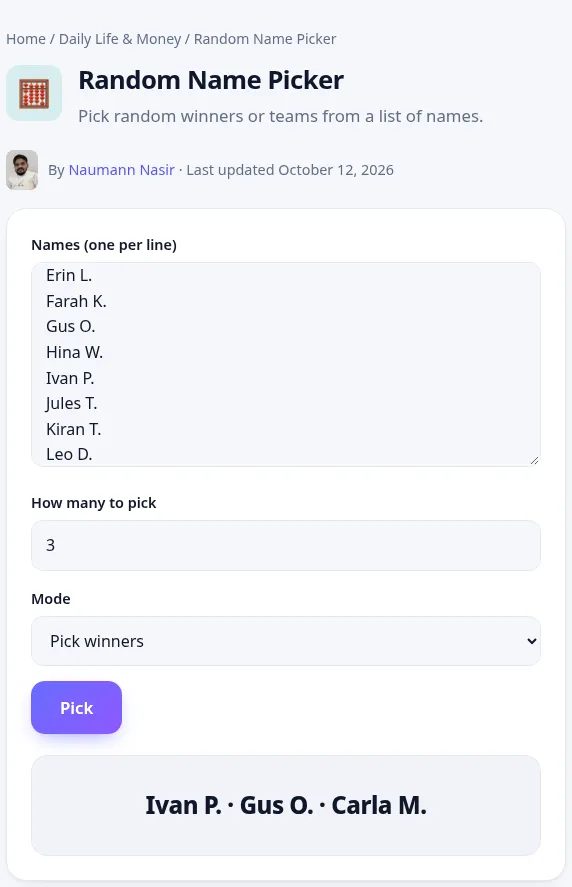
The tool returned Ivan P. · Gus O. · Carla M.. I treat the order as meaningful. Ivan wins. If Ivan does not reply by the deadline in your rules, Gus is next, then Carla. Picking the backups in the same draw is better than re-running the tool later, because nobody can say you kept pressing the button until you liked the answer.
If you set the number higher than the number of names, the tool simply returns every name in shuffled order. If you set it to 0, it still picks one.
The mistake that makes a draw unfair: duplicate entries
The picker does not remove duplicates. That is deliberate in some cases (a raffle where one person bought three tickets should have three lines), but in a "one entry per person" giveaway it is a problem. I tested this list 100,000 times:
| Line in the list | Times picked first (of 100,000) |
|---|---|
| Amna (appears twice) | 33,368 |
| Bilal | 16,698 |
| Carla | 16,746 |
| Dev | 16,606 |
| amna (lower case) | 16,582 |
Two things show up. "Amna" listed twice wins twice as often, exactly as you would expect. And "amna" in lower case is treated as a different person, so if those three lines were the same commenter, she had three chances while everyone else had one.
Before a draw, clean the list:
- Paste the entries into a spreadsheet and remove duplicates. In Google Sheets that is Data → Data cleanup → Remove duplicates.
- If names came in with mixed capitals, convert them to one case first. The Case Converter turns a whole list to lower case in one step.
- Remove anyone your rules exclude, such as staff, before you shuffle, not after.
Example 2: Secret Santa without anyone drawing themselves
The classic paper-slips method fails when someone pulls their own name and everyone has to draw again. A shuffled list avoids that. Put everyone in, choose Shuffle all, and read the result as a circle: each person buys for the name below theirs, and the last person buys for the first.
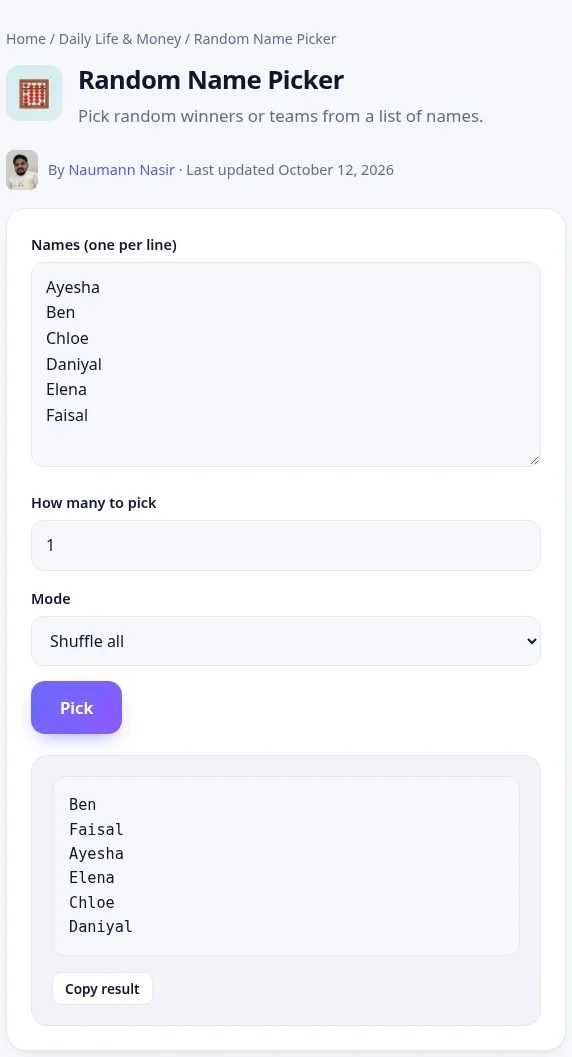
The shuffle gave Ben, Faisal, Ayesha, Elena, Chloe, Daniyal. So Ben buys for Faisal, Faisal for Ayesha, Ayesha for Elena, Elena for Chloe, Chloe for Daniyal, and Daniyal for Ben. Nobody can get themselves, and everyone gives exactly one gift and gets exactly one.
Two honest limits of this method:
- The organiser sees every pair. If the organiser is also playing, the surprise is gone for them. Ask someone outside the group to run the shuffle and send each person only their own match.
- No exclusions. If couples should not draw each other, check the circle by eye. If an excluded pair sits next to each other (including last-to-first), shuffle again. Decide this rule before the first shuffle, so a re-run is a rule, not a preference.
Example 3: random teams
For seven people in teams of three, choose Make teams of 3:
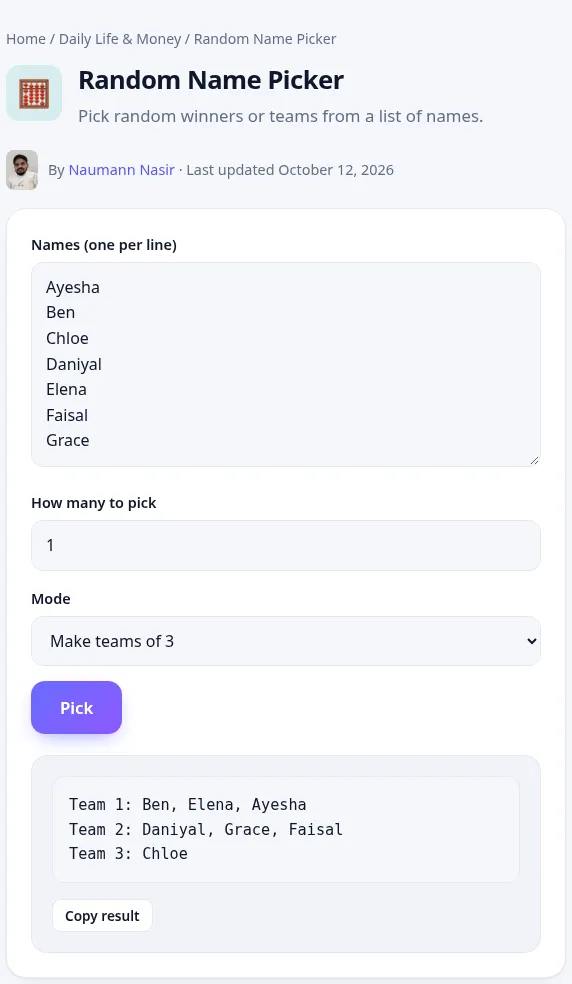
The tool fills teams in order, so the remainder lands in the last team. Here Chloe ended up as a team of one. The tool will not rebalance that for you. My fix is to move the leftover person into one of the full teams (making a team of four) or, if teams must be even, to use Make teams of 2 and merge pairs by hand. The only modes are pairs and threes, so for teams of four or five, use Shuffle all and cut the list every four or five names yourself.
Running a giveaway people trust
Randomness is only half of it. The other half is being able to show what you did. This is the routine I use:
- Write the rules first, including the closing date and time with a time zone, who can enter, how many entries each person gets, how you pick, and how long the winner has to reply.
- Freeze the entry list at the closing time and save a copy. Screenshots of comments work for small giveaways.
- Clean it for duplicates and excluded people, as above.
- Screen-record the draw, showing the full list, the settings and the result. Pick the winner and backups in one go.
- Announce the result and contact the winner the way your rules said you would.
If you run the giveaway on Instagram, Instagram's own Promotion Guidelines put the responsibility for the rules on you. They say you are responsible for the official rules, eligibility terms and following the laws that apply, that each entrant must give a complete release of Instagram, and that the promotion must say it is not sponsored, endorsed, administered by or associated with Instagram. They also say you must not ask people to tag themselves in photos they are not in. Prize promotion laws differ by country and, in the US, by state, so check the rules where you run it before offering anything valuable.
What about the Wheel Spinner?
The site also has a Wheel Spinner, which is more fun to show on a stream or in a classroom. It works differently: the spin length comes from Math.random, the browser's general-purpose random function. That is fine for choosing who presents first or what to have for lunch. For a draw with a prize, I use the Name Picker, because it uses the cryptographic generator and gives you winners and backups from a single shuffle. For quick yes or no calls there is also the Decision Maker.
Limitations
- No duplicate removal and no case matching, as shown above.
- No saved history or draw ID. The tool cannot prove a draw happened, which is why the screen recording matters.
- Teams come only in twos and threes, and leftovers go in the last team.
- Very long lists work, but the result box shows winners on one line, so for more than a handful of winners, Shuffle all is easier to read.
Quick takeaways
- One clean line per valid entry. Duplicates double someone's chances.
- Pick the winner and backups in one draw, and treat the order as the backup order.
- For Secret Santa, shuffle once and read the list as a circle.
- Write the rules before the giveaway opens and record the draw.
Frequently asked questions
Is an online name picker really random?
This one shuffles with the browser's cryptographic random generator, and in my 120,000-run test each of 12 names came up about one time in twelve. "Random" still depends on the list. If the list has duplicates or missing entries, the draw is random over the wrong list.
Can I give some people extra entries?
Yes. Add their name once per entry. Say so in your rules, and keep in mind that some platforms do not allow extra entries in exchange for likes, follows or shares.
Can I re-draw if the winner does not reply?
Set a reply deadline in your rules and pick backups in the original draw. Then a missing winner means moving to the next name, not running a new draw.
More free daily life & money tools
Age Calculator
Find your exact age in years, months and days.
🧮Date Difference Calculator
Count days, weeks and months between two dates.
🧮Loan and EMI Calculator
Calculate monthly payment, total interest and total cost.