 USA AI Tools
How Much Should I Save Each Month to Reach a Goal?
 By Naumann Nasir · Last updated
"How much do I need to put away each month?" is the question behind most savings plans, whether the goal is a deposit, a car or a cushion in case your job changes. It came up again this week: on October 26, Microsoft announced a Voluntary Exit Offer for eligible staff in the US, Canada, India and the UK, and CNBC reported that around 60,000 people are eligible, with decisions due in early December. You do not need to work at Microsoft for the lesson to land. Knowing how long it takes to build a cash buffer is useful before anyone hands you a choice.
Below are four worked examples I ran in the site's Savings Goal Calculator on October 27, 2026, including two places where the result can surprise you.
How the calculator does the math
You enter four numbers: the goal, what you have already saved, a monthly deposit and an annual interest rate. The tool then steps forward one month at a time. Each month it adds one twelfth of the annual rate as interest, then adds your deposit, and it stops at the first month the balance reaches the goal. It reports:
- Time to goal in years and months (always whole months).
- Reach goal around, counted forward from the current month.
- Total deposits, which is what you already had plus every monthly deposit, not counting interest.
Because the dates count from today, you will see different month names if you run the same numbers later.
Example 1: $10,000 in three months
One query that brings people to the calculator is some version of "how to save $10k in 3 months". The plain division is $10,000 / 3 = $3,333.34 a month. Entering goal 10000, already saved 0, monthly deposit 3334 and rate 4 gives 0 years, 3 months, goal reached around January 2027, total deposits $10,002.00.
Now drop the deposit to a rounder $3,300:
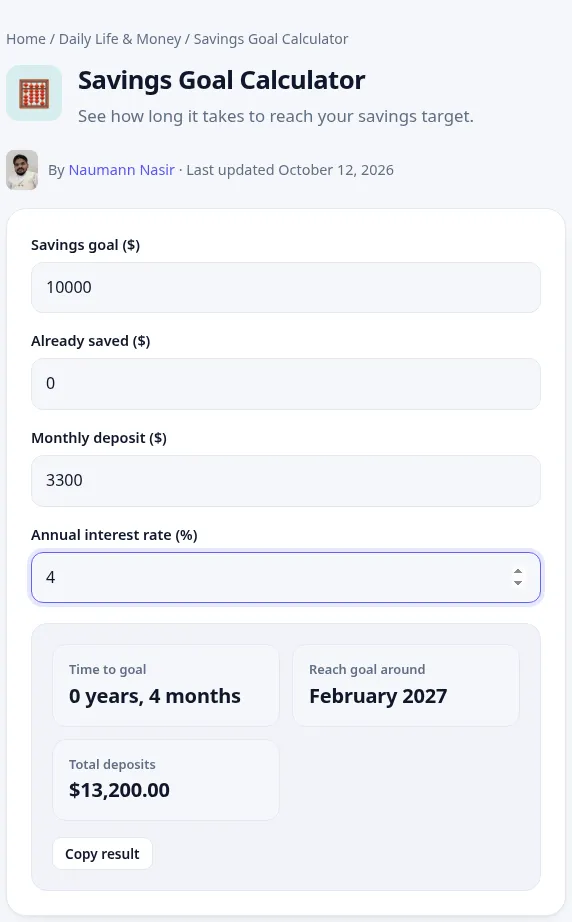
The answer jumps to 4 months and total deposits to $13,200.00. That looks odd until you work it out by hand: after three deposits the balance is about $9,933, so you are roughly $67 short. The tool does not do partial months, so it adds a whole fourth deposit of $3,300. In real life you would just top up the last $67. Two lessons here:
- Over a few months, interest barely matters. At 4% a year, three months of deposits earn about $33. The deposit amount does almost all the work.
- If the result looks like it overshoots, check whether you are just short of the line. Adding a few dollars to the monthly deposit often pulls the date back by a full month.
Example 2: an emergency fund
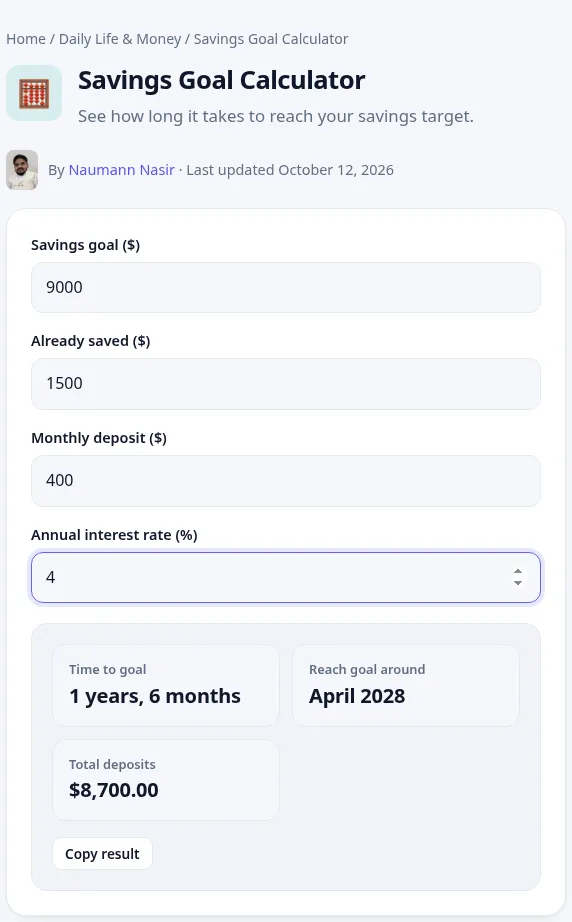
The US Consumer Financial Protection Bureau's guide to emergency funds does not give a one-size target. It suggests looking at the kind of unexpected costs you have actually had and how much they cost, then setting a goal and saving automatically. So pick a number that fits your life. For this example, say your essential bills are $3,000 a month and you decide on three months of them: $9,000. You already have $1,500 put aside and can save $400 a month in an account paying 4%.
| Monthly deposit | Rate | Time to $9,000 | Reached around | Total deposits |
|---|---|---|---|---|
| $400 | 0% | 1 year, 7 months | May 2028 | $9,100.00 |
| $400 | 4% | 1 year, 6 months | April 2028 | $8,700.00 |
| $600 | 4% | 1 year, 1 month | November 2027 | $9,300.00 |
Interest at 4% saves you one month here, worth about $300 over the period. Raising the deposit by $200 saves five months. That pattern holds for most short goals: find money for the deposit first, then shop around for the rate.
If you are not sure where the $400 or $600 comes from, the 50/30/20 budget guide shows how to carve a savings line out of take-home pay with the Budget Planner.
Example 3: a fixed term, working backwards
Another real search: someone planning a 24-month goal with £1,000 monthly deposits at 1.35%. The calculator shows a $ sign, but the math does not care about currency, so you can type pounds, rupees or dirhams and read the results in the same currency.
The calculator answers "how long?", not "how much will I have?", so I worked it out by hand first. With the tool's method (interest each month at 1.35% / 12, then the deposit), 24 deposits of 1,000 grow to about 24,313. Entering goal 24310, already saved 0, deposit 1000, rate 1.35 confirms 2 years, 0 months and total deposits of 24,000. So at that rate the interest adds a bit over 300 across two years. Your bank may pay interest daily or credit it on a different day, so expect a small difference from its own figure.
Example 4: saving weekly instead of monthly
The tool only takes a monthly deposit. If you get paid weekly, convert: a year has 52 weeks and 12 months, so a weekly amount times 52 / 12 (about 4.33) is the monthly equivalent. $92.31 a week is about $400 a month, so the emergency fund example above works the same if you save weekly. If you are paid hourly, the Salary Converter helps you see what a weekly saving is as a share of your pay.
How to find the deposit you need for a deadline
There is no "required deposit" box, so use a quick bracket:
- Divide what is left (goal minus already saved) by the number of months you have. That is your starting guess.
- Enter it. If the tool shows one month more than you wanted, you are slightly short. Raise the deposit by a small amount and try again.
- Stop at the lowest deposit that gives your target month. Interest will only lower it a little for short goals.
For goals measured in decades, interest starts doing more of the work. The Compound Interest Calculator shows a year-by-year table of deposits versus interest, which is easier to read for long horizons.
Limitations to keep in mind
- Fixed rate. Savings rates change. The tool assumes the rate you type stays the same the whole time.
- No tax, fees or inflation. Interest may be taxable where you live, and $9,000 in 2028 buys less than $9,000 today.
- End-of-month deposits. Deposits are added after each month's interest. If you deposit at the start of the month, you earn slightly more.
- Whole months only. As example 1 showed, being a few dollars short adds a full month and a full deposit to the totals.
- Small label quirk. The result says "1 years" for one year. It is the same number, just not grammatical.
- Not advice. This is arithmetic, not a recommendation about how much you should keep in savings or where. If you are weighing a severance or buyout offer, read the actual terms and talk to a qualified adviser.
Quick takeaways
- For goals under two years, the monthly deposit matters far more than the interest rate.
- If a result looks one month too long, you are probably a few dollars short. Nudge the deposit.
- Pick an emergency fund target from your own past costs, as the CFPB suggests, then automate the deposit.
- The calculator works in any currency. Ignore the $ sign.
Frequently asked questions
How much do I need to save a month to reach $10,000 in a year?
$10,000 / 12 is $833.34. With a 4% rate you could go slightly lower. Enter 820 and the calculator still shows 12 months, so interest covers the gap. Try your own rate to see where the line falls.
Does the calculator include the money I already saved in "Total deposits"?
Yes. Total deposits is your starting amount plus every monthly deposit. The difference between the goal and that figure is roughly the interest earned, unless the final month overshoots.
Can I use it for debt payoff?
Not directly. Paying down a loan works the other way round, because interest is charged on the balance. Use the Loan EMI Calculator for that, or see Planning a Car Purchase, which combines a savings goal with a loan payment.
More free daily life & money tools
Age Calculator
Find your exact age in years, months and days.
🧮Date Difference Calculator
Count days, weeks and months between two dates.
🧮Loan and EMI Calculator
Calculate monthly payment, total interest and total cost.