 USA AI Tools
Building a Monthly Budget With the 50/30/20 Rule
 By Naumann Nasir · Last updated
A monthly budget fails most often because the categories are vague. "Spend less" is not a plan. The 50/30/20 rule gives three clear buckets for take-home pay: about 50% for needs, 30% for wants and 20% for savings and debt repayment. It is a starting point, not a law, and it works best when you plug in real numbers and adjust.
This guide builds a full example with the free Budget Planner and Savings Goal Calculator on this site. All totals below come from those tools with the inputs shown. They are educational estimates, not personal financial advice.
What counts in each bucket
- Needs (about 50%): rent or mortgage, basic utilities, groceries, required insurance, minimum debt payments, childcare you need for work, and a basic phone/internet plan.
- Wants (about 30%): dining out, streaming, hobbies, nicer upgrades, most shopping that is not essential, and travel that is not for work.
- Savings and debt (about 20%): emergency fund contributions, retirement deposits, extra payments above the minimum on loans, and sinking funds for known future costs.
If a cost disappears when you lose your job, it is usually a want. If life becomes unsafe or unsustainable without it, it is usually a need. Grey areas exist; pick a rule and stay consistent month to month.
Example: $4,200 take-home with classic 50/30/20
Open the Budget Planner. Enter monthly take-home income 4200, Needs 50, Wants 30, Savings and debt 20.
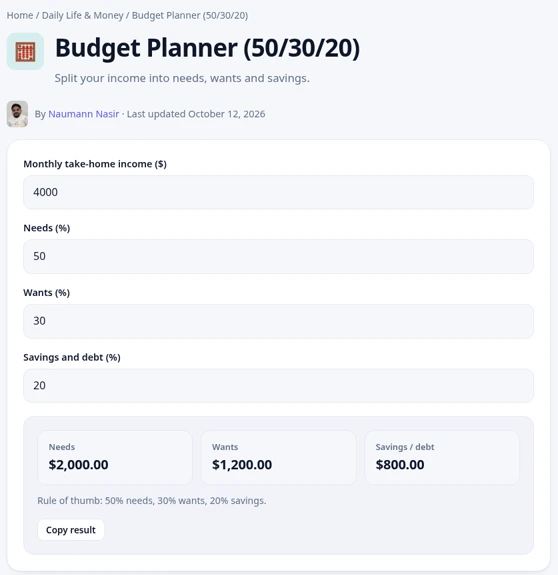
The tool returns:
- Needs: $2,100.00
- Wants: $1,260.00
- Savings / debt: $840.00
Those three lines are caps, not suggestions to spend up to. If needs only cost $1,900, the spare $200 can move into savings without waiting for a "perfect" month.
Turn the savings line into a goal date
Suppose you already have $500 in an emergency fund and want $10,000. You decide the full $840 savings bucket goes there for now, and the account earns about 4% annual interest. In the Savings Goal Calculator, enter goal 10000, already saved 500, monthly deposit 840, annual rate 4.
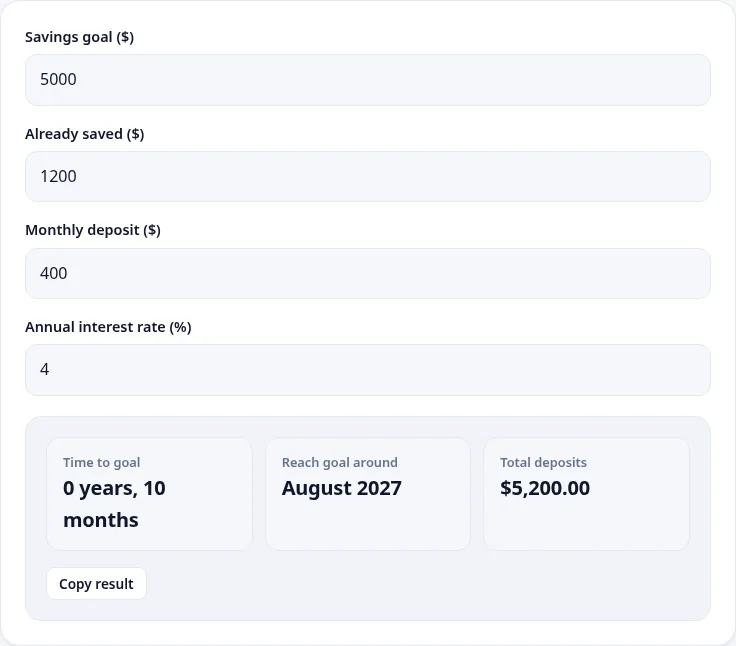
Result:
- Time to goal: 1 year, 0 months
- Reach goal around: October 2027 (from a run dated October 2026)
- Total deposits: $10,580.00
Interest helps a little: with the same deposits at 0% interest, the tool still needs 12 months of $840 plus the $500 already saved ($10,580 in deposits) to clear $10,000. The 4% rate mainly shortens edge cases and grows the balance after you hit the goal.
If you can only spare $400 a month toward the same $10,000 goal (with $500 saved and 4% interest), the calculator says 1 year, 11 months, around September 2028, with total deposits of $9,700.00. Halving the deposit almost doubles the wait.
When 50/30/20 does not fit
High rent cities often push needs above 50%. Try income 3200 with Needs 55, Wants 25, Savings 20:
- Needs: $1,760.00
- Wants: $800.00
- Savings / debt: $640.00
The tool still accepts the split. Its note only warns when percentages do not add to 100%. Cutting wants to protect savings is usually healthier than dropping the savings line to zero "until things calm down," because calm months are rare.
Another adjustment: income 4200, Needs 60, Wants 25, Savings 15:
- Needs: $2,520.00
- Wants: $1,050.00
- Savings / debt: $630.00
That 15% savings line is still $630 a month. Pointed at a $3,000 starter emergency fund with $200 already saved and no interest, $250 a month reaches the goal in 1 year, 0 months (total deposits $3,200.00). You do not need a perfect 20% to make progress.
Higher income example
At $5,500 take-home with classic 50/30/20:
- Needs: $2,750.00
- Wants: $1,650.00
- Savings / debt: $1,100.00
Aim that $1,100 at a $20,000 goal with $2,000 already saved and 4.5% interest. The Savings Goal Calculator returns 1 year, 4 months (around February 2028) and total deposits of $19,600.00. Interest and the starting balance cover the gap between deposits and the $20,000 target.
Build the budget in one sitting
- Use take-home pay. Enter what lands in your account after tax, not gross salary.
- List last month's spending from your bank or card app. Sort each line into needs, wants or savings/debt.
- Run the Budget Planner with 50/30/20, then change the percentages until needs match reality without wiping out savings.
- Give the savings line a job in the Savings Goal Calculator: emergency fund, car down payment, or debt payoff target.
- Recheck after payday two, not after one quiet week. One month of data beats a hopeful spreadsheet.
Debt minimums vs extra payments
Minimum credit card or loan payments belong in needs, because missing them damages your credit and triggers fees. Extra payments belong in the 20% bucket. If high-interest debt is the emergency, it is reasonable to send most of that 20% at the debt until the balance is gone, then redirect the same amount to savings so the habit stays.
Common mistakes
- Budgeting from gross pay. Tax is not optional spending.
- Calling everything a need. If the category cannot breathe, wants will leak through cash and "one-off" purchases.
- Saving only what is left. The rule works when savings is assigned first inside the 20% line.
- Ignoring sinking funds. Annual insurance premiums and holiday spending are predictable; park a monthly slice in savings so they do not look like surprises.
- Never revisiting the split. A raise, a move or a new dependent should trigger a fresh run of the planner.
A sample month inside the $4,200 plan
Numbers only help when they map to real bills. One possible layout for the $2,100 needs cap:
- Rent: $1,350
- Utilities and internet: $180
- Groceries: $320
- Transport and basic car costs or transit: $150
- Minimum debt payments and required insurance: $100
That adds to $2,100 on the nose. The $1,260 wants budget might cover two restaurant meals, a streaming bundle, a hobby class and a small clothing purchase. The $840 savings line could be $500 to the emergency fund and $340 as an extra payment on a card. If groceries run over, the overage should come from wants the same month, not from skipping the transfer to savings.
Track the first month with three labels only. You do not need twenty subcategories on day one. After you trust the three buckets, split groceries from dining out so the needs line stays honest.
Related reading on this site
If a car loan is eating the needs bucket, walk through Planning a Car Purchase: Loan Payment, Down Payment and Budget. For percentage changes when prices or income shift, see How to Calculate Percentage Increase and Decrease.
Quick checklist
- Enter take-home income in the Budget Planner.
- Start with 50/30/20, then adjust percentages so they still total 100%.
- Write down what sits inside needs for your household.
- Send the savings/debt amount into the Savings Goal Calculator with a real target.
- Review after two pay cycles and trim wants before you cut savings to zero.
The 50/30/20 rule is useful because it is simple enough to remember on payday. The tools make sure the simple rule still matches the numbers in your account.
More free daily life & money tools
Age Calculator
Find your exact age in years, months and days.
🧮Date Difference Calculator
Count days, weeks and months between two dates.
🧮Loan and EMI Calculator
Calculate monthly payment, total interest and total cost.